When I first saw the headlines screaming about TMC the metals company’s latest losses – a staggering US$184.52 million for the quarter and US$279.45 million year-to-date – my first thought wasn't panic, but a deep sense of déjà vu, honestly. It’s the kind of noise that makes the mainstream financial press clutch their pearls and question everything, prompting articles that ask Should TMC the metals' (TMC) Surging Losses Prompt Investors to Revisit Its Financial Trajectory? But for those of us who peer beyond the quarterly reports, who see the grand arc of human innovation, this isn't a red flag. It's the expected, glorious growing pains of a truly audacious endeavor.
The Deep Dive into Tomorrow's Resources
Let's be clear: the numbers are real. TMC is burning through capital, and yes, they're not generating revenue yet. This isn't a secret, nor is it unexpected for a company literally pioneering a new industry at the bottom of the ocean. Imagine trying to build the Transcontinental Railroad not just across a continent, but across the unexplored, crushing depths of the Pacific. You don't get that done with pocket change, and you certainly don't get it done without setbacks, without unexpected engineering challenges, or without the kind of capital outlay that would make a less visionary company blanch.
The investment narrative for TMC has always been a long game, a bet on the future of deep-sea mining. And why is this bet so compelling? It's not just about profit; it’s about necessity. We are on the cusp of an unprecedented global energy transition, and that transition—from electric vehicles to massive renewable energy infrastructure—demands an incredible volume of critical metals: nickel, cobalt, copper, manganese. These aren't just obscure elements; they are the literal building blocks of the future we all want, the one that’s cleaner, more connected, and more sustainable. Traditional land-based mining faces increasing environmental and social pressures, and quite frankly, the easy deposits are getting harder to find. The deep sea, that alien landscape of hydrothermal vents and abyssal plains, holds polymetallic nodules that are incredibly rich in these very materials. It’s like discovering a new continent overflowing with the exact resources our evolving civilization needs most.
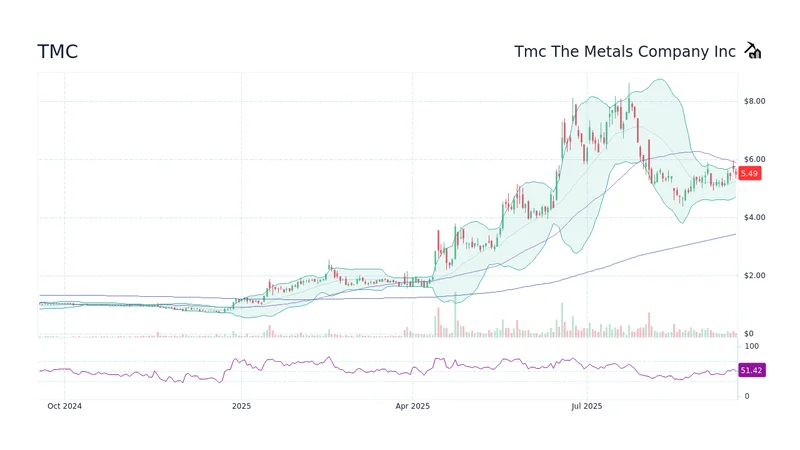
This isn't just about the tmc stock price today; it's about the strategic imperative of tomorrow. Can we really put a quarterly price tag on securing the resources that will power the next century? Is the immediate balance sheet truly the sole arbiter of a venture that could fundamentally reshape global supply chains and accelerate our shift away from fossil fuels? I don't think so. The very notion that these losses should prompt a crisis of confidence feels, to me, like looking at a sapling and complaining it's not yet a mighty oak.
Navigating the Uncharted Waters of Innovation
Of course, the path isn't smooth. We’re talking about an entirely new regulatory framework, complex engineering in extreme environments, and the critical responsibility to ensure environmental stewardship. That's why regulatory progress and permit approvals are such huge catalysts for TMC. These aren't just bureaucratic hurdles; they are the necessary steps to build a responsible, sustainable industry. And frankly, any enterprise of this magnitude, operating at this scale, will face "ballooning costs" in its early stages. That's the price of admission to a new frontier.
It’s fascinating to watch the market grapple with this, isn't it? The Simply Wall St Community, for example, shows fair value estimates for TMC ranging from a meager US$1.05 to a soaring US$10.50 per share. That wide spread isn't just "divided outlooks"; it's a testament to the chasm between those who see only the immediate costs and those who grasp the monumental potential. It’s a classic case where, as the old adage goes, "extraordinary investment returns rarely come from following the herd." The herd is looking at the latest tmc stock news and panicking about dilution, while the visionaries are looking at the next fifty years of global resource demand.
This is where the human element, our ingenuity and our tenacity, really shine. We're talking about developing technology that can operate under immense pressure, precisely collect nodules with minimal disturbance, and bring them safely to the surface. The speed of innovation in this area, in robotics and materials science, is just staggering—it means the gap between what's challenging today and what's feasible tomorrow is closing faster than we can even comprehend, and companies like TMC are at the forefront of pushing that boundary. This is the kind of breakthrough that reminds me why I got into this field in the first place, seeing human potential unlock what once seemed impossible.
Now, let's be thoughtful. With great power comes great responsibility, and exploring the deep sea demands an unwavering commitment to understanding and protecting these unique ecosystems. TMC, and indeed the entire industry, must operate with the highest ethical standards, investing heavily in research to minimize impact and ensure the long-term health of our oceans. This isn't just a compliance issue; it's a moral imperative.
The Future Isn't Built on Yesterday's Balance Sheet
So, what’s the real story here? It's not about the current financial ebb and flow of TMC. It's about the relentless march of progress, the undeniable need for critical resources, and the human spirit that dares to venture where no one has gone before. These "losses" aren't failures; they're the tuition fees for humanity's next great leap forward. The future isn't built on yesterday's balance sheet; it's forged by today's audacious visionaries, pushing the boundaries of what's possible, despite the inevitable turbulence of uncharted waters. The horizon beckons, not the balance sheet.